
Centers for Dialysis Care Foundation Supports Care for Patients with Chronic Kidney Disease
September 14, 2023

Boosting UH Nephrology and Hypertension Service’s chronic kidney disease management and prevention efforts, the Centers for Dialysis Care (CDC) Foundation has awarded $300,000 to launch UH’s Kidney Care Navigator Program, called CAN Kidney for short. The CDC’s support for CAN Kidney, which began in 2022, is part of a $2.05 million, three-year grant to UH that will last through 2024.
Chronic kidney disease (CKD) disproportionately affects minority and underserved populations, often lurking undetected and without symptoms. According to the Centers for Disease Control and Prevention, about 35.5 million Americans have CKD – but 9 in 10 of those do not know it.
By providing CKD education and encouraging dialysis candidates to act early, CAN Kidney can improve health outcomes and morbidity rates, explained Mahboob Rahman, MD, UH Division Chief, Nephrology and Hypertension and Peter B. DeOreo, MD, Endowed Chair in Nephrology and Dialysis. “CAN Kidney helps patients learn about home dialysis care, receive kidney transplant assessments, and manage CKD-related disorders like anemia,” he said.
Building Trust for Better Care
“But our patients must first trust us to even want to learn about their condition and set up appointments,” stressed Aparna Padiyar, MD, UH nephrologist and project lead. “A lot of our patients are saying, ‘Nobody has talked to me about this. I feel perfectly fine.’ And because the health care system has often failed them, they have no impetus without behavioral health supports, which CAN Kidney helps patients navigate and access.”
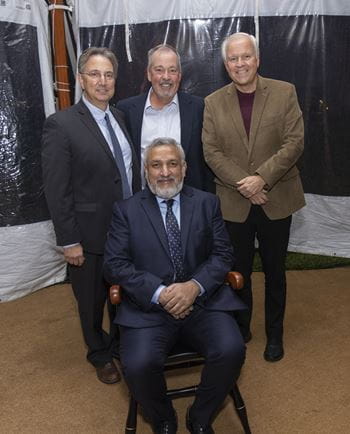
Back, from left to right: Gary Robinson, President & CEO, Centers for Dialysis Care; Ronald C. Hess, Chair, Centers for Dialysis Care Foundation; Richard Spech, MD, Chief Medical Officer, Centers for Dialysis Care.
In addition to assisting patients with finding behavioral health supports, the CDC’s grant also protects dedicated time for the team to implement new technologies for better patient data management. A chat platform helps serve patients remotely, furthering education and building trust. A patient dashboard meticulously tracks referrals, provider statistics and patient statuses, helping prioritize critical cases.
Since CAN Kidney started in 2022, appointment no-show rates have dropped significantly, more dialyses have started successfully, and more patients have connected with UH specialty care providers, such as vascular surgeons, endocrinologists and more.
The CDC Foundation has supported UH’s Division of Nephrology and Hypertension for more than two decades. UH and CDC have also partnered to launch the Northeast Ohio Renal Research Innovation Award program, now in its fifth year. In addition, CDC has also established two Master Clinicians as well as the Peter B. DeOreo Endowed Chair in Nephrology and Dialysis, held by Dr. Rahman.
“We are proud to collaborate with organizations like University Hospitals that are interested in improving care for patients in our local community,” said Gary Robinson, President of the Centers for Dialysis Care. “These initiatives have certainly made a positive impact.”
Dr. Padiyar emphasized that UH and the CDC are committed to the spectrum of kidney care. “The CDC has been a wonderful partner,” she said. “Because of CAN Kidney, we can leverage other aspects of dialysis care and take many future directions.”
View more information on the CAN Kidney Program and its services at University Hospitals.

We can make an impact at UH and in our community Because of You.